ADHD

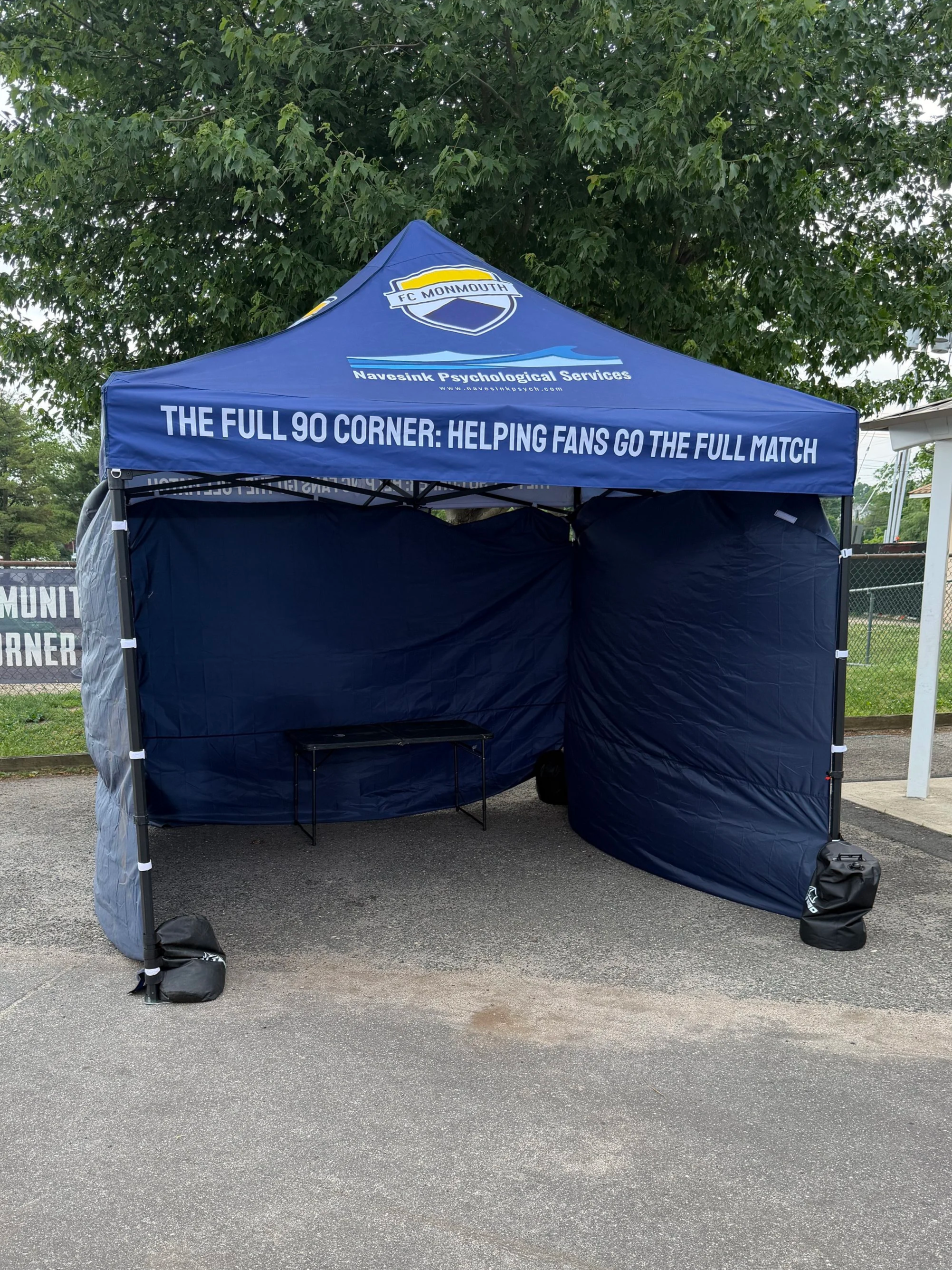
Going the Full 90: NPS and FC Monmouth Launch a First-of-Its-Kind Fan Space

First-of-its-kind initiative in U.S. semi-professional soccer debuts at Count Basie Park in Red Bank, New Jersey.


FC Monmouth, a semi-professional soccer club that plays its home matches at Count Basie Park in Red Bank, New Jersey, has partnered with Navesink Psychological Services (NPS), a Red Bank-based mental health practice, to launch "The Full 90 Corner." The initiative is a sensory-support space built to give fans a calm, safe environment during home matches. FC Monmouth and NPS say it is the first space of its kind in U.S. semi-professional soccer.

Key Facts
InitiativeThe Full 90 Corner, a fully enclosed, sensory-support space for fans
PartnersFC Monmouth (semi-professional soccer club) and Navesink Psychological Services, also known as NPS (mental health practice)
LocationCount Basie Park, Red Bank, New Jersey
DebutMay 28, at the FC Monmouth women's team home opener
Ongoing availabilityAll future FC Monmouth men's and women's home matches

A partnership built on mental performance since 2023

Dr. Matthew Strobel, founder and owner of Navesink Psychological Services, has served as FC Monmouth's Mental Skills Consultant since 2023. In that role, Dr. Strobel has worked individually with players and the coaching staff across both FC Monmouth's men's and women's rosters, with a focus on supporting mental well-being on and off the field. The Full 90 Corner grew out of that ongoing partnership.

Why FC Monmouth built the space

The Full 90 Corner was created to make match day more inclusive for fans who may become overwhelmed by the sensory stimulation of a live sporting event. It debuted at the FC Monmouth women's team home opener on May 28 and will remain available at every home match going forward.

FC Monmouth General Manager James Davis said the club wanted to extend its fan experience beyond the standard game day:

"At FC Monmouth, we strive to go above and beyond for the typical fan experience at this level. When Matt approached us with this concept to support those who join us for home matches, it was a no-brainer."
James Davis, General Manager, FC Monmouth

What fans should know before stepping in

Dr. Strobel said the space is meant to lower the barrier for fans who may hesitate to use it:

"The Full 90 Corner is an opportunity to take a break while still being able to enjoy the high level of play that the FC Monmouth players bring to every match. Sometimes the stands can be overwhelming, and the Full 90 Corner allows fans to get the full experience in a sensory-friendly environment. We want our fans to do what the players do: go the Full 90, enjoying every match."
Dr. Matthew Strobel, Founder, Navesink Psychological Services

Part of a broader shift in sports mental health

Dr. Strobel connected the initiative to a wider trend across sports:

"More and more athletes are willing to discuss mental health as they realize it relates to their performance. There is a trickle-down effect from the highest-level athletes and teams using sports psychologists, which has helped reduce stigma for all athletes. Sports psychologists are considered another coach, one focused on improving the mental aspect of the game. The Full 90 Corner further demonstrates commitment to supporting mental health and wellness in another way."
Dr. Matthew Strobel, Founder, Navesink Psychological Services

Wellness Awareness Night, June 6

FC Monmouth Home Match · June 6
FC Monmouth further highlighted these efforts during its Wellness Awareness Night home match on June 6. The event featured a pre-match networking tailgate for mental health businesses and practitioners, on-field skills work with RallyCap participants and FC Monmouth players, and a resource fair showcasing wellness and support organizations from across the community.

For upcoming community events and wellness initiatives, visit Navesink Psychological Services at navesinkpsych.com. For FC Monmouth home match schedules and tickets, visit fcmonmouth.com/home-matches.

About FC Monmouth

FC Monmouth is a semi-professional soccer club founded in 2017, based in Monmouth County, New Jersey, and playing its home matches at Count Basie Park in Red Bank. The club's men's team competes in The League for Clubs, and its women's team competes in the Women's Premier Soccer League (WPSL). FC Monmouth's stated mission is to connect, inspire, and entertain its community through soccer. James Davis serves as General Manager. More information is available at fcmonmouth.com.

About Navesink Psychological Services

Navesink Psychological Services (NPS) is a Red Bank, New Jersey-based mental health practice founded in 2016 by Dr. Matthew G. Strobel, Psy.D. NPS provides therapy, evaluations, consultation, and sport psychology services for children, adolescents, adults, and families, and has served as FC Monmouth's Mental Skills Consultant partner since 2023. More information is available at navesinkpsych.com.

Frequently asked questions

What is the Full 90 Corner?
It's a fully enclosed, sensory-support space at FC Monmouth home matches, built for fans who may feel overwhelmed by the noise and stimulation of a live soccer game while still letting them follow the action.
Where is it located?
At Count Basie Park in Red Bank, New Jersey, FC Monmouth's home stadium.
When did it launch, and how often is it available?
It launched May 28 at the FC Monmouth women's team home opener and will be available at every FC Monmouth home match going forward.
Who created it?
FC Monmouth and Navesink Psychological Services, in a partnership proposed by NPS founder and FC Monmouth Mental Skills Consultant Dr. Matthew Strobel.
Is it the first space of its kind?
FC Monmouth and NPS describe it as the first sensory-support space of its kind in U.S. semi-professional soccer.
What else are FC Monmouth and NPS doing on mental health?
Dr. Strobel and NPS have supported FC Monmouth players and staff since 2023, and the club hosts a Wellness Awareness Night every year with a mental health resource fair and recently added a practitioner tailgate.

The Full 90 Corner reflects a broader commitment from FC Monmouth and Navesink Psychological Services to make mental health support visible, accessible, and woven into everyday community spaces.

For media inquiries or to learn more about NPS sport psychology and consultation services, contact our team directly.

Contact NPS FC Monmouth home matches

Found this helpful?

Share it with someone who might benefit, or explore more resources from the Navesink Psychology team.

More articles Get in touch

Why Early ADHD Diagnosis Matters!

A landmark 2026 study tracked 580,000 students and found that when a child is diagnosed with ADHD matters just as much as whether they are diagnosed at all.


When ADHD comes up in conversation, the focus almost always lands on how to manage it: medication, behavioral therapies, classroom accommodations, symptom patterns. But there is a crucial piece of the conversation that gets skipped over far too often. Timing.

A 2026 study published in JAMA Psychiatry, titled "Age at First Attention-Deficit/Hyperactivity Disorder Diagnosis and Educational Outcomes," makes a compelling case for why we need to rethink how we approach the timeline of an ADHD diagnosis. Led by researcher J. Volotinen and a team at the University of Helsinki, the longitudinal study tracked a population-based cohort of roughly 580,000 students in Finland to examine how the age at which a child is first diagnosed shapes their long-term academic future.

The findings are a significant wakeup call.

580,000
students tracked in the study cohort
3x
higher dropout risk for late vs. early diagnosis in boys
JAMA
Psychiatry, 2026 — peer-reviewed longitudinal research

The cost of delayed diagnosis

For a long time, there has been a lingering "wait and see" sentiment around ADHD in children. Maybe they will grow out of it. Maybe a label will do more harm than good. Even within families who are well-informed about mental health, there is often a hesitation to seek early testing out of concern that a diagnostic label might stigmatize a young child.

But this study tells us clearly that the real risk lies in waiting.

Individuals who were diagnosed later in development, specifically closer to age 16, faced significantly harsher educational outcomes. When a child's ADHD goes unnoticed or unaddressed until adolescence, they spend years trying to meet expectations without the tools or support they need to do so.

GPA outcomes by age of diagnosis
Boys diagnosed at age 4Avg. GPA 7.12
Boys diagnosed at age 16Avg. GPA 6.52
Girls diagnosed at age 6Avg. GPA 7.64
Girls diagnosed at age 12Avg. GPA 6.95
Probability of completing academic upper secondary degree
Boys diagnosed at age 420.77%
Boys diagnosed at age 155.29%
Girls diagnosed at age 431.04%
Girls diagnosed at age 1412.01%
Probability of school dropout
Boys diagnosed at age 49.16%
Boys diagnosed at age 1629.52%
Girls diagnosed at age 69.57%
Girls diagnosed at age 1327.16%

By the time a teenager reaches high school, years of academic frustration, internalized failure, and chronic stress have already accumulated. This is not just about grades. It is about how a child has come to understand themselves. When a brain that processes the world differently is never given the framework to make sense of that, the story a child tells about themselves becomes: I am not smart enough. I am not trying hard enough. Something is wrong with me. In reality, their brain simply functions differently, and they have been navigating without the support systems they need.

The cost of a delayed diagnosis is not just academic. It is the years of accumulated self-doubt that become harder to undo the longer they go unaddressed.

Early intervention changes everything

The study's silver lining is just as clear as its warning. Earlier age at ADHD diagnosis was consistently associated with better long-term school performance, a higher likelihood of pursuing higher academic education, and a significantly reduced risk of school dropout.

An early diagnosis is not about boxing a child in with a label. It is about opening the door to targeted support before negative patterns of academic failure and low self-esteem become entrenched and hard to break. When ADHD is identified early, we can implement coping strategies, set up classroom accommodations, and provide emotional support during the years when the foundation of a child's academic identity is still being built. We can stop asking a child to try harder at something their brain is not yet equipped to do without support, and start giving them the tools to actually do it.

Speaking from personal experience navigating mental health and academic spaces: receiving a clear framework can provide immense relief. It offers the realization that struggles are not a reflection of effort or character. There is something tangible and valid occurring, and it can be managed with the right resources.

Girls are being left behind

One of the most telling insights from this data is how certain populations are being consistently underserved by delayed testing. Girls with ADHD are far more likely to present with inattentive symptoms, meaning they internalize their struggles rather than act out. They are frequently diagnosed much later than boys, or never diagnosed at all. They suffer in silence, their intelligence often masking how hard they are working just to keep up, until the academic demands of high school or college finally become too much.

The gap between early and late diagnosis outcomes for girls in this study is not a small statistical footnote. It is a significant, measurable difference in life trajectory. And it is largely preventable.

Frequently asked questions

At what age should I consider having my child evaluated for ADHD?
There is no single right age, but the research strongly suggests that earlier is better. If you are noticing consistent patterns of inattention, impulsivity, or difficulty with self-regulation that are affecting your child's learning or daily functioning, it is worth exploring an evaluation rather than waiting to see if things improve on their own. A comprehensive evaluation can provide clarity at any age.
Will an ADHD diagnosis label my child negatively?
This is one of the most common concerns parents raise, and it is completely understandable. The research consistently shows the opposite effect: children who receive an early diagnosis tend to perform better academically and emotionally than those who go undiagnosed. A diagnosis does not define a child. It opens the door to support, accommodations, and strategies that allow them to succeed on their own terms.
How is ADHD in girls different from ADHD in boys?
Girls with ADHD more commonly present with inattentive symptoms rather than hyperactive or impulsive ones. This means they may appear daydreamy, disorganized, or quietly overwhelmed rather than disruptive. Because these symptoms are less visible, they are often missed or attributed to other causes, leading to significantly later diagnosis. If your daughter is struggling academically or emotionally in ways that do not quite fit other explanations, ADHD is worth exploring.
What does an ADHD evaluation at Navesink Psychological Services involve?
Our evaluations are comprehensive and use multiple data sources including clinical interviews, rating scales, standardized testing, and direct observation. The goal is not just to confirm or rule out ADHD, but to develop a full picture of your child's profile including any co-occurring conditions, learning differences, or emotional factors, and to provide actionable recommendations for moving forward.
Source: Volotinen, J., Remes, H., Martikainen, P., et al. (2026). Age at First Attention-Deficit/Hyperactivity Disorder Diagnosis and Educational Outcomes. JAMA Psychiatry. Read the full study on JAMA Network

We cannot afford to wait until a child is on the verge of dropping out to figure out why they are struggling. Timely evaluation is a lifeline that protects a child's academic future, preserves their mental health, and gives them what they need to thrive.

If you suspect your child may be dealing with ADHD, do not buy into the "wait and see" approach. Our team at Navesink Psychological Services is here to help.

Learn about our evaluations

Found this helpful?

Share it with someone who might benefit, or explore more resources from the Navesink Psychology team.

More articles Get in touch

Why Simple Strategies Can Work Best

I was watching the Japan match with my kids when a coach grabbed a whiteboard and stopped me cold. It took me a few minutes to realize how brilliant it really was.


I was sitting at home watching the Japan vs. Netherlands match with my kids when I noticed something odd on the sideline. Japan's coach, Hajime Moriyasu, was holding up a whiteboard. My first reaction was confusion. What is he doing? And then: why would a coach use a whiteboard to show the time when there are screens everywhere and the entire stadium is a wall of technology?

It took me a few minutes to really get it. And when I did, I thought: that is genuinely brilliant.

Group F · June 14, 2026 · Dallas Stadium
Netherlands 2 – 2 Japan
Goals: Van Dijk 50', Nakamura 57', Summerville 64', Kamada 89'

Japan were down 2-1 with the clock running out. Moriyasu walked to the sideline and held up large handwritten numbers counting down the minutes remaining. No shouting. No tablet. No headset. Just numbers on a board, unmissable to every player on the pitch. And in the 89th minute, Daichi Kamada deflected home an equalizer. Japan finished 2-2 against one of the tournament favorites.

In a stadium roaring with 70,000 fans, a whiteboard said everything that needed to be said without a single word being spoken.

Why it worked

Here is what clicked for me. A roaring stadium swallows sound. Verbal instructions from the sideline, shouted across 60 yards of pitch, get lost before they arrive. But a visual prompt held up at eye level? Every player sees it instantly, including the wide attackers who are furthest from the bench. No ambiguity. No miscommunication. Just: this is how much time you have left, now go.

Zlatan Ibrahimovic put it well:

"I've seen a lot in football, big clubs, big egos, big money, but what Hajime Moriyasu did against the Netherlands? That's genius. Pure leadership. While the big European teams are busy with their fancy tablets and shouting into the noise, this man pulls out a simple whiteboard with giant handwritten numbers and outsmarts everyone. Respect."
Zlatan Ibrahimovic, June 2026

I also suspect this was not a spontaneous idea. Moriyasu was spotted using the same technique at halftime too. This was a rehearsed system, which is exactly why it worked so cleanly under that level of pressure. You cannot pull something out for the first time in the 89th minute of a World Cup match and expect it to land. The team already knew what it meant.

My desk is covered in Post-its

The moment I understood what Moriyasu was doing, I thought of my own desk. Right now there is a Post-it for people I need to call back, one for blog ideas I want to write, and one for things I need to follow up on at home. Writing them down means I can focus on the task in front of me without carrying the mental weight of trying not to forget everything else. The note holds it so my brain does not have to.

I recommend the same thing to clients constantly, especially those dealing with ADHD or executive functioning challenges. A small whiteboard on the fridge: what food needs to be bought, what is already there so you can figure out what to make. One by the front door: what you need to take when you leave. Sometimes one in the bathroom: the morning routine in order, shower, dry off, brush teeth, comb hair, get dressed. Not because people cannot figure those things out, but because when you are dysregulated, tired, or distracted, a visible prompt is the difference between getting it done and spending 20 minutes trying to remember what comes next.

In a stadium of 70,000 screaming fans, with a World Cup on the line, Moriyasu's players were essentially dysregulated. Adrenaline, pressure, fatigue. The whiteboard cut through all of it the same way a Post-it on the bathroom mirror cuts through a chaotic Monday morning.

The most effective tool is not always the most sophisticated one. It is the one that gets through when everything else is competing for your attention.

How to put this to work

  • 1
    Whiteboard on the fridge
    Two columns: what you need to buy, and what you already have. It takes 30 seconds to update and saves the daily "what's for dinner?" spiral. Visible, simple, always there.
  • 2
    Note by the front door
    Whatever needs to leave the house with you goes here the night before. Keys, permission slip, lunch, medication. You see it on the way out. Nothing gets left behind.
  • 3
    Morning routine in the bathroom
    For kids and adults alike, a simple ordered list on the mirror removes the need to remember what comes next. This is especially helpful for anyone with ADHD or executive functioning challenges who gets stuck mid-routine and loses track.
  • 4
    The two-pronged backup
    Worried about losing a Post-it? Write it, then photograph it on your phone. You get the analog visibility of the physical note and the digital safety net of the photo. Both serve a purpose at different moments in the day.

Frequently asked questions

Why do visual cues work better than verbal reminders for people with ADHD?
People with ADHD often have difficulty with working memory, which means verbal instructions can fade before they are acted on. Visual cues stay in the environment and continue to prompt without requiring the person to hold information in their head. They reduce reliance on memory and make the desired behavior more immediately accessible.
Is there a psychological reason why simplicity is more effective under pressure?
Yes. Under stress and high arousal, cognitive bandwidth narrows. Complex instructions that work fine in a calm environment become much harder to process when the pressure is on. Simple, clear cues cut through because they demand less processing. This is why rehearsed, minimalist systems tend to hold up in high-stakes moments better than elaborate ones.
How can I help my child use visual strategies at school?
Start small and involve your child in creating the system. A visual schedule on their desk, a checklist on the inside of their locker, or a simple color-coded planner can make a significant difference. The key is consistency and keeping the cues visible and meaningful to the child rather than overwhelming them with too much information at once.
When should I consider a formal evaluation for executive functioning challenges?
If you or your child are consistently struggling with organization, time management, task initiation, or follow-through in ways that are affecting daily life, school, or work, a comprehensive evaluation can identify the underlying profile and guide more targeted strategies. Simple visual tools are a great starting point, but they work best when the full picture is understood.

I was genuinely elated watching Japan pull off that late equalizer. And I was even more elated watching a whiteboard help make it happen. It was a good reminder that the simplest tools are often the most powerful, on the pitch and off it.

If you or your child are struggling with organization, executive functioning, or ADHD and want support building strategies that actually work in real life, our team is here.

Reach out for a free consultation

Found this helpful?

Share it with someone who might benefit, or explore more resources from the Navesink Psychology team.

More articles Get in touch

From Correction to Compassion: Supporting Your Child With ADHD

Why the ratio of encouragement to correction matters more than most parents realize — and what to do about it.


Kids with ADHD typically hear a steady stream of correction — a lot more than their peers. Not because they're "worse," but because impulsivity, forgetfulness, and distractibility are more visible. Over time, that constant correction can chip away at motivation and self-esteem in ways that are hard to reverse.

The antidote isn't manufactured praise. It's a genuine, consistent shift in focus: catching kids doing things right, and making sure they hear about it far more often than they hear about what went wrong. If you're unsure whether ADHD is at the root of what you're seeing, a comprehensive evaluation can be a helpful starting point.

Kids with ADHD need to feel seen for what they're doing right far more often than for what they're doing wrong.

One useful guideline is a roughly 10-to-1 ratio of positive feedback to corrections. That number isn't meant to be tracked obsessively — it's a reminder that encouragement needs to significantly outweigh correction, especially for kids who are already getting corrected more than most. If you notice that most of your interactions with your child are corrections, that's the signal to shift, not to count.

A few things to keep in mind about positive reinforcement: it works best when it's genuine. Forced or exaggerated praise is something kids pick up on quickly, and it can backfire. The goal isn't a performance — it's noticeably more encouragement woven into ordinary moments across the day.

6 strategies that actually help

  • 1
    Catch small wins constantly
    Don't wait for big achievements. Noticing and naming small wins builds momentum and helps kids begin to see themselves as capable.
    • "You started your homework without me asking."
    • "I noticed you stayed in your seat for those five minutes."
    • "You remembered your backpack — that's progress."
  • 2
    Make praise specific, not generic
    "Good job" fades quickly. Specific praise sticks because it tells the child exactly what they did and why it mattered.
    • "You kept trying even when that was hard."
    • "I noticed you're really working on staying focused."
  • 3
    Separate the child from the behavior
    This protects your child's identity. Framing corrections around choices — not character — keeps the relationship intact and makes the feedback easier to hear.
    • "That choice didn't work — let's try that again."
    • Instead of: "You're being disruptive."
  • 4
    Keep corrections short and neutral
    Long lectures don't land well with ADHD. A calm tone, few words, and a clear direction is almost always more effective than an extended explanation.
  • 5
    Use pre-correction
    A quick check-in before a challenging situation reduces the need for correction afterward. It primes the child to self-regulate rather than react.
    • "What's the plan when we go into class?"
    • "What's one strategy you can use if you feel the urge to call out?"
    Reduces negative feedback before it's needed
  • 6
    Make positives visible
    Simple tools like "caught being mindful" notes or a visible tally of positive moments make success concrete for kids who may not internalize verbal praise as easily. This isn't a bribe — it's a way of making progress feel real.

Frequently asked questions

Isn't praise just going to make my child expect rewards all the time?
Genuine, specific praise builds intrinsic motivation over time — it's not the same as offering rewards for every behavior. The goal is to help your child notice and feel good about their own progress, not to create a transactional dynamic. The more they internalize a positive self-image, the less external reinforcement they'll need.
What if my child barely has any positive moments to catch?
Start smaller. Look for moments like sitting still for 30 seconds, making eye contact, or walking calmly into a room. For kids who have been in a long cycle of correction, even micro-moments count. The bar needs to meet your child where they actually are — not where you wish they were.
Does this approach work at school too?
Yes, and it can make a significant difference. Teachers who use specific positive feedback and pre-correction strategies typically see fewer behavioral disruptions and better engagement from students with ADHD. Sharing these strategies with your child's teacher — or asking their therapist to connect with the school — can help create consistency across settings.
When should we consider professional support?
If your child's self-esteem, motivation, or behavior at home or school is significantly impacted, a therapist who specializes in ADHD and child development can be a valuable partner. At Navesink Psychological Services, we work with children, families, and schools to build consistent, strengths-based approaches that extend well beyond the therapy room.

Changing a correction-heavy pattern takes time, especially when you're tired and the behaviors are genuinely hard. But small, consistent shifts in how your child hears from you can make a real difference in how they see themselves — and that matters far beyond any single behavior.

If you'd like support building these strategies at home or connecting them to what's happening at school, our team is here to help.

Learn more at Navesink Psychology

Found this helpful?

Share it with someone who might benefit, or explore more resources from the Navesink Psychology team.

More articles Get in touch

Pediatrician vs. Psychologist for an ADHD Evaluation: Which Is Best for Your Child?

When families begin exploring whether their child may have ADHD, one of the first questions that comes up is who should do the evaluation. Two common options are a pediatrician or a psychologist, and while both can diagnose ADHD, the type of evaluation and the level of detail you receive can be very different. Understanding the strengths and limitations of each can help you choose the right fit for your family.

When a Pediatrician May Be the Right Choice

For many families, the pediatrician is the first stop and sometimes that’s all that’s needed.

Pros of a Pediatrician Evaluation

✔ Quick and accessible
Pediatricians can usually provide an ADHD evaluation within a short timeframe. If you need documentation quickly, for school, accommodations, or medication management, this can be very helpful.

✔ Familiar with your child
Most pediatricians know their patients well and already have a long-term medical history, which can support their clinical decision-making.

✔ Adequate for straightforward ADHD cases
When the primary goal is simply to confirm ADHD and begin medication, pediatricians often use brief rating scales completed by parents (and sometimes teachers), along with a brief interview and in-office observation.

Cons of a Pediatrician Evaluation

✘ Typically brief and limited in scope
Pediatricians usually do not conduct comprehensive assessments. Their evaluations often rely on checklists rather than deeper testing.

✘ May miss learning or emotional comorbidities
ADHD commonly occurs alongside anxiety, learning differences, or executive functioning challenges. These are difficult to identify without a more detailed psychological evaluation.

✘ Treatment support outside of medication may be limited
While pediatricians are essential for medication management, they often cannot provide detailed recommendations for behavioral, academic, or therapeutic interventions.

When a Psychologist Is the Better Choice

If you want a deeper understanding of your child, not just a yes/no diagnosis, a psychologist can provide a far more comprehensive evaluation.

Pros of a Psychological Evaluation

✔ Thorough and comprehensive
Psychologists use multiple data sources: clinical interviews, rating scales, standardized tests, direct observation, and cognitive or academic assessments. This leads to a fuller picture of your child’s profile.

✔ Identifies comorbidities
Psychologists can assess for anxiety, depression, autism, learning disorders, executive functioning issues, and more. This matters because the majority of children with ADHD have at least one additional challenge that affects treatment.

✔ Personalized treatment recommendations
You don’t just walk away with a diagnosis; you get a roadmap. Psychologists provide individualized strategies for home and school, behavioral recommendations, and guidance for therapy, accommodations, and skill-building.

✔ Ongoing support beyond medication
Families often find that psychologists provide an additional layer of support for understanding behaviors, advocating at school, and navigating long-term needs.

Cons of a Psychological Evaluation

✘ Takes longer
Comprehensive testing can take several hours, and reports may take time to complete.

✘ Higher upfront cost
Psychological evaluations tend to be more expensive, though the depth of information can offer substantial long-term value.

✘ Availability may be limited
It can take time to find a psychologist with openings who specializes in ADHD and child assessment.

Which Should You Choose?

A pediatrician may be sufficient if:

  • You need quick documentation of ADHD

  • The case seems straightforward

  • Your primary goal is to access for medication

A psychologist is the better choice if:

  • You want a deep understanding of your child’s strengths and challenges

  • You suspect learning issues or other emotional/behavioral concerns

  • You want detailed, individualized treatment and school recommendations

  • You want support beyond medication management

Bottom Line

Both pediatricians and psychologists play important roles in supporting children with ADHD. The right choice depends on what you’re hoping to learn, the complexity of your child’s needs, and how comprehensive you want the evaluation to be.

If your goal is simply to document ADHD quickly, a pediatrician can usually meet that need. But if you want a full picture of your child’s functioning, learning style, and any co-occurring conditions, along with a tailored plan for moving forward, a psychologist is typically the best option.

Found this helpful?

Share it with someone who might benefit, or explore more resources from the Navesink Psychology team.

More articles Get in touch

“What’s the best planner for a student with ADHD?”

Unfortunately, there isn’t a single right answer. The truth is, the best planner is the one your student will actually use, and one that fits within the systems they already rely on. A beautifully designed planner doesn’t do much good if it sits unopened at the bottom of a backpack!

Start with the Ecosystem

Before buying anything new, look at what the college or school already has in place. Many universities now use online learning management systems (like Canvas or Blackboard) that include calendars, task lists, and notification features. Building out from those existing tools, rather than trying to create a completely separate system, helps reduce friction and increases the odds that your student will stick with it.

Structure Over Stationery

Even more important than the planner itself is the structure and routine around how it’s used. For example:

  • Set a weekly planning time: Every Sunday night, review upcoming assignments, exams, and commitments, and map out the week ahead.

  • Create a start-of-semester ritual: When new classes begin, add all major due dates and exam days into the planner or app.

  • Check in regularly: Early on, it can help to have frequent check-ins — either with a parent, coach, or counselor — to make sure systems are working. Over time, these can fade as the student gains independence and confidence.

Without these habits, even the most perfect planner won’t make much difference.

Don’t Forget Campus Resources

If your student doesn’t already have academic supports in place, reach out to the disability services office (sometimes called accessibility services or student support services). They can offer accommodations, coaching, and tools that make organization and time management more manageable.

Bottom Line

The best planner for an ADHD student isn’t a product; it’s a process.  Find something that integrates with their existing tools, build consistent routines, and reinforce those habits until they stick. That’s where real progress happens.

Found this helpful?

Share it with someone who might benefit, or explore more resources from the Navesink Psychology team.

More articles Get in touch