CBT

Tips for Managing Catastrophizing

Practical strategies from a psychologist on recognizing and moving through catastrophic thinking.


I was recently interviewed for an article in Parade Magazine on the traits of people who often catastrophize. It's a topic that comes up constantly in my work with clients, and I wanted to expand on some practical strategies here for anyone looking to get a better handle on their own catastrophic thinking.

Catastrophizing is not a character flaw. It is a natural feature of how our brains are wired — and with the right tools, it's something you can learn to work with rather than against.
  • 1
    Start with awareness
    Ask yourself: "How big do I think this problem is compared to how a close friend or loved one would rate it?" You can even take it a step further and actually ask that friend to weigh in. If your rating is significantly higher than theirs, that's a signal you may be catastrophizing. The gap between how we perceive a problem and how others see it is often one of the clearest early indicators.
  • 2
    Don't add shame to the pile
    When you catch yourself catastrophizing, resist the urge to criticize yourself for it. This kind of thinking is a natural part of our survival system — it's hardwired into our brains and has served an important purpose throughout human history. Accepting that catastrophizing is something most people experience, and that it can even be helpful at times, keeps you from adding more fuel to an already burning fire.
  • 3
    Play it out
    Ask yourself: if what I'm afraid of actually happened, what would I do? How would I manage it? Draw on past experiences where you've navigated difficult situations and found your way through. Catastrophizing often creates tunnel vision — we see only the problem and nothing else. The solutions are usually there. We just need to shift our focus enough to find them.
  • 4
    Take action
    Think about what you can do right now. Sometimes that means giving yourself permission to step away from the problem — deciding that further thought isn't helpful in this moment and scheduling a specific time to return to it. Getting outside, moving your body (a quick walk, a short workout), or simply changing your environment can open up new ways of thinking. Bringing your full attention to one task — how does the walk feel, how many push-ups can I do — shifts focus and creates space for a clearer headspace.
  • 5
    Don't hesitate to ask for help
    Too often, people end up catastrophizing about the fact that they're catastrophizing, and then feel ashamed or embarrassed to bring it up. Reach out to a trusted friend or a mental health professional and let them help you examine your thought patterns. And who knows — with some practice, you might become the friend someone else turns to when they need that same steady perspective.

Frequently asked questions

Is catastrophizing a mental health disorder?
Not on its own. Catastrophizing is a cognitive pattern — a way of thinking — that most people engage in to some degree. It becomes a concern when it's frequent, intense, and significantly interferes with daily life or decision-making. It often shows up alongside anxiety and depression, and is something that responds well to therapy.
Can therapy really help with catastrophizing?
Yes. Cognitive Behavioral Therapy (CBT) in particular is very effective for identifying and shifting catastrophic thought patterns. At Navesink Psychological Services, our clinicians use evidence-based approaches to help clients develop more balanced, realistic thinking.
How do I know if I catastrophize more than average?
The friend check-in described in Tip 1 is a great starting point. If you consistently find that others rate your problems as much smaller than you do, or that you frequently imagine worst-case outcomes that don't materialize, it may be worth exploring with a professional.
What's the difference between catastrophizing and being cautious?
Healthy caution is proportional and action-oriented — it helps you prepare for realistic risks. Catastrophizing tends to be disproportionate, difficult to control, and often leads to paralysis rather than preparation. The key distinction is whether the thinking is helping you take useful action or keeping you stuck.

Catastrophizing is one of the most common thinking patterns I encounter in my practice, and one of the most treatable. With awareness, self-compassion, and the right strategies, it's entirely possible to change your relationship with worst-case thinking — and to feel more grounded and capable when life gets hard.

If you'd like support working through anxiety or unhelpful thought patterns, our team at Navesink Psychological Services is here to help.

Reach out at Navesink Psychology

Cannabis Use and Mental Health

Cannabis and Mental Health

​​Clients and their families often ask about cannabis use to treat mental health concerns when working with our providers at Navesink Psychological Services in Red Bank, NJ. George Halliwell, LPC often works with clients looking to reduce cannabis use.

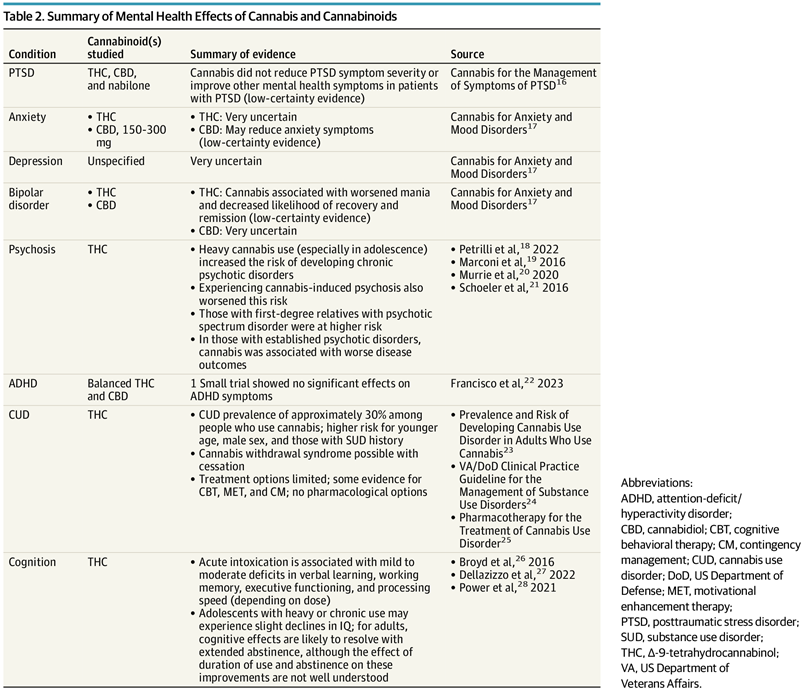
Kansagara, Terry, Ayers, et al. recently published Cannabis and Mental Health A Review describing the current research on cannabis use for mental health conditions as well as the effects of cannabis use. While clients will often report anecdotal evidence that cannabis use improves their mental health conditions, studies have not shown positive effects. Currently, there is no mental health condition for which cannabis is currently supported as a treatment, yet there are substantial documented harms. 

Mental Health Diagnoses

For PTSD, Kansagara describe two clinical trials, the largest of which found no difference in PTSD symptom severity between cannabis and placebo. Of note, the sample was 80 veterans so overall the study was small and with a select group of individuals. One small study found nabilone (synthetic THC) reduced nightmares but not sleep quality overall. Evidence is low-certainty and insufficient to recommend cannabis for PTSD. 

For Anxiety, THC has unpredictable effects: a low dose (7.5 mg) reduced anxiety in some people, while a higher dose (12.5 mg) induced it. CBD at 150–300 mg/day shows some early promise for generalized and social anxiety disorder, but evidence is still low-certainty and more trials are needed.

For Depression, almost no clinical trials exist. Cannabis does not appear to improve depression, and heavier use is associated with increased suicidality and self-harm. 

For Bipolar Disorder, seven observational studies consistently show cannabis worsens mania, reduces recovery, and leads to worse social and employment outcomes. Patients with bipolar disorder should be clearly advised against cannabis use, especially high-THC products.

The area of clearest and most alarming risk is Psychosis. Up to 50% of people who experience cannabis-induced psychosis go on to develop schizophrenia or other chronic psychotic disorders. One 2024 longitudinal study found an 11-fold increased risk of psychotic disorders associated with adolescent cannabis use. Daily use (vs. no use) roughly doubles the risk of psychosis. People with a family history of psychotic disorders are at even greater risk.

Cannabis is frequently self-used for ADHD, but the one small clinical trial found no benefit on attention, memory, or cognition. Acute intoxication actually mimics ADHD symptoms.

About 30% of people who used cannabis in the past year meet criteria for Cannabis Use Disorder (CUD). There are no FDA-approved medications to treat it. Cognitive Behavioral Therapy (CBT), motivational enhancement therapy, and contingency management have some evidence. At Navesink Psychological Services, our team has expertise in CBT, motivational interviewing, and behavioral management, strategies that help clients reduce cannabis use and empower them to make different choices.

In a more general sense, cannabis use impacts Cognition. THC acutely impairs memory, executive function, and processing speed. Adolescents who use regularly may experience lasting IQ declines. In adults, cognitive effects likely improve with sustained abstinence, but the timelines are unclear.

High Risk Groups

While we know that cannabis use does not currently show evidence to treat mental health concerns, it is especially important to consider high risk groups that should be strongly discouraged from cannabis use. These groups include:

  • Adolescents and young adults (developing brains)

  • People with bipolar disorder

  • People with psychotic or psychosis-risk conditions (including those with a first-degree relative with psychosis)

  • Pregnant individuals (moderate-certainty evidence of preterm birth and low birth weight)

  • Those with a history of substance use disorder

Summary of Mental Health Effects of Cannabis and Cannabinoids